
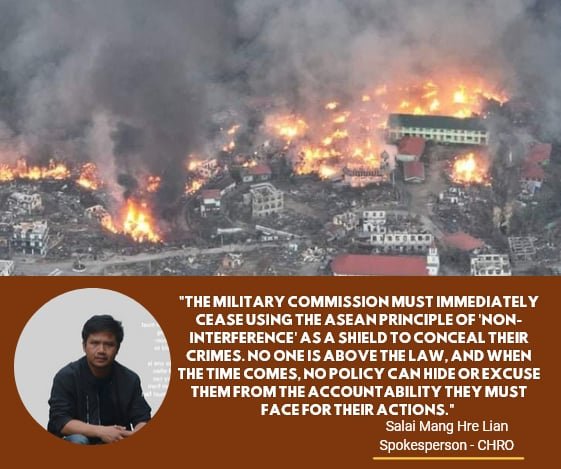
“The Military Commission must immediately cease using the ASEAN principle of ‘non-interference’ as a shield to conceal their crimes. No one is above the law, and when the time comes, no policy can hide or excuse them from the accountability they must face for their actions.”
An exclusive interview was conducted with Salai Mang Hre Lian, spokesperson for the Chin Human Rights Organization (CHRO), regarding the lawsuit filed against the Military Commission in the courts of Timor-Leste and the international judicial prospects for Myanmar.
Interviewer: DonBosco
Q: How will the Military Commission’s recent expulsion of the Timor-Leste Charge d’Affaires affect the case submitted by CHRO? Will this action stall the momentum of the case, or will it further strengthen it?
A: First and foremost, the Myanmar Military Commission’s expulsion of the Timor-Leste embassy is a completely groundless act. This action proves, firstly, that the Military Commission is attempting to cover up their crimes. Furthermore, it clearly demonstrates their fear and their desire to avoid any accountability for the offenses they have committed.
Secondly, the act of severing diplomatic ties and expelling a diplomat has alerted the entire world to the situation in Myanmar. I believe this will garner more support for Timor-Leste’s stance with the Myanmar people and reinforce the judicial commitment of the Timor-Leste courts to achieving justice for Myanmar.
Therefore, the Military Commission’s actions will not hinder the proceedings of the Timor-Leste judiciary. On the contrary, I believe it will strengthen the resolve to stand with the people of Myanmar. I would like to take this opportunity to call upon the global public and governments to stand together with the Myanmar people and the Timor-Leste judicial department.
Q: The Military Commission alleges that Timor-Leste is interfering in internal affairs and violating the ASEAN Charter. However, the Military Commission itself has failed to implement the ASEAN Five-Point Consensus, particularly regarding the cessation of violence and humanitarian issues. How does CHRO analyze this?
A: The Five-Point Consensus is the most crucial policy within ASEAN. It was agreed upon by all ASEAN nations and signed by the perpetrator of the violence themselves, making it a significant achievement.
However, the Military Commission has failed to comply even with the first point of the Five-Point Consensus: the immediate cessation of violence and killings. Instead of adhering to it, we see them escalating violent killings and atrocities against the public on a daily basis.
Given these circumstances, ASEAN nations must pay closer attention to the Military Commission’s failure to honor these agreements to uphold regional stability and the rule of law. We believe ASEAN nations will provide further support and assistance to Timor-Leste’s efforts in implementing ASEAN policies regarding the rule of law and stability.
Q: Since this case is proceeding through the Universal Jurisdiction pathway, could the breakdown in diplomatic relations pose a legal barrier? How much confidence does CHRO have in the judicial mechanism of Timor-Leste to move forward with the case?
A: Universal Jurisdiction exists in many countries. The nature of this jurisdiction is not for one state to sue another, but a judicial system that opens the door to prosecuting those who have committed war crimes and atrocities within a country.
Because Universal Jurisdiction is within the legal framework of Timor-Leste, CHRO’s filing of a lawsuit for war crimes and crimes against humanity is a solid legal path. This prosecution does not conflict with the ASEAN Charter or the procedures of the Timor-Leste courts.
The Timor-Leste court is an independent judicial body, and we do not believe the government or administrative apparatus will interfere in its actions. Timor-Leste is a nation that values justice. Having faced war crimes and crimes against humanity themselves, we believe their judiciary will seriously consider and act upon our request to address the war crimes committed against us. Given the independence of the Timor-Leste judiciary and their own history, we fully believe they will act with empathy to ensure the truth prevails.
Q: It is understood that you will collaborate with civil society organizations (CSOs) in Timor-Leste on this case. As diplomatic channels close, how do you intend to push the case forward through these civil networks?
A: In the diplomatic and political sectors, CSOs are vital because they have the power to influence a government’s policies. Public participation is also key. We believe the people of Timor-Leste will closely monitor the diplomatic relations between the Myanmar government and their own.
When we visited Timor-Leste, we met with CSO leaders and organizations. They did not expect the conditions we are facing in Myanmar to be this severe. When we showed documentaries collected by CHRO of the Military Commission’s daily aerial terrorist attacks and killings, they were deeply saddened, and some were moved to tears.
Consequently, they pledged to stand with us to the best of their ability to ensure justice is served in their country. They offered words of encouragement, stating they would urge their government and relevant officials to take action on this matter.
CHRO will work in harmony with CSOs in Timor-Leste. The role and support of CSOs in other ASEAN and international countries are also crucial, as they influence their respective governments’ policies. Therefore, we intend to connect further with CSOs in other regions, just as we have in Timor-Leste.
Q: While ASEAN nations like Indonesia, Malaysia, and the Philippines do not recognize the Myanmar elections, Timor-Leste’s stance is also very clear. How can these internal disagreements within ASEAN create opportunities for the justice CHRO is seeking?
A: This is a very encouraging point. Decisions have emerged from some ASEAN nations declaring the Military Commission’s actions illegitimate and refusing to recognize them. Timor-Leste’s firm stance at this time provides us with even more strength.
Countries in the ASEAN region that respond so decisively can be considered democratic nations with the rule of law. When Timor-Leste opens a path for justice, it serves as a significant reminder to other countries about the importance of the rule of law and regional stability as enshrined in the ASEAN Charter.
Therefore, Timor-Leste’s actions will serve as a catalyst for other nations to stand more firmly on the Myanmar issue, addressing not only Min Aung Hlaing’s failure to follow the Five-Point Consensus but also the core ASEAN values of the rule of law and regional stability. I believe Timor-Leste’s cooperation with other nations will strengthen the implementation of the Five-Point Consensus.
Q: As tensions rise with the Military Commission expelling the Timor-Leste diplomat, some people doubt whether an effective judicial outcome is possible amidst diplomatic complications and political pressure. Will the case stall on paper due to closed diplomatic channels? How would CHRO respond, and what solid paths exist for a practical result?
A: If we look back at international judicial history, individuals prosecuted under Universal Jurisdiction and for other international crimes may face a long process, but they never escape punishment. History shows many instances where actions were taken to ensure accountability for the deeds committed.
Therefore, we have full confidence in the Timor-Leste judiciary. If this court declares the leaders of the Military Commission as international criminals, international arrest warrants will be issued, and their room for movement will be significantly narrowed.
To use a common analogy: if one person among a group of four or five is labeled a thief, dacoit, or murderer, no one wants to associate with them anymore. Being designated as an international criminal will severely damage their image on the international stage, making it extremely difficult for others to engage with them, especially in economic and diplomatic relations.
Looking at the current situation in Myanmar, the emergence of the “Kyat-Phant” (Cyber Scams) issue has already led to many sanctions and disruptions in financial flows, affecting even their business partners.
Furthermore, ASEAN nations are constantly interacting with one another; it is unavoidable. Being labeled an international criminal will block many of their travel routes. They will face insecurity due to arrest warrants wherever they travel, including for medical treatment.
While the Military Commission’s severance of ties with Timor-Leste is an attempt to hide their crimes, it only reinforces the fact that they are international criminals. They will no longer be able to live comfortably within ASEAN as before. It will impact them economically, politically, and in terms of their image. The key point is that no one is above the law. Although there is no accountability at this moment, these records and events will not disappear even in 10 or 20 years. When the time comes, the moment for accountability will always be following them.
Q: CHRO also filed complaints in Indonesia regarding the Military Commission’s war crimes, whereas in Timor-Leste, a case has been opened. What is the status of the previous efforts, and how does the current case in Timor-Leste differ?
A: While Universal Jurisdiction exists in Indonesia, we did not file a formal case there. Although they have Universal Jurisdiction, their constitution and enacted laws typically only accept cases occurring within Indonesia. Therefore, lawyers in Indonesia are currently working to amend laws to open the path for Universal Jurisdiction because of these constitutional contradictions.
If their laws are amended and the path is opened, we will be able to prosecute there just as we are in Timor-Leste. At this stage, we have only submitted proposals for them to amend their laws.
However, in Timor-Leste, the judicial department and laws are already clear. They explicitly state that those who have committed international crimes can be prosecuted in their judicial department. No other laws prevent this, which is why we were able to file a direct lawsuit in Timor-Leste. Now, the Timor-Leste court has accepted our case and has already appointed individuals to handle the ongoing investigation.
Q: Now that the Timor-Leste court has accepted the case and hearings are set to proceed, it is uncertain whether the accused from the Military Commission will appear. Without them, what evidence will be used to build a strong case? Furthermore, since Timor-Leste is an ICC member, how much international impact will these verdicts have?
A: I have explained specifically how the Timor-Leste judiciary will proceed. They have accepted the case we submitted and will begin hearings. In doing so, the court may issue summons for the individuals we have prosecuted. However, it is certain they will not appear in court to testify.
But there is a UN mechanism established for Myanmar called the IIMM (Independent Investigative Mechanism for Myanmar). Their job is to collect evidence of human rights violations, war crimes, and crimes against humanity occurring in Myanmar.
If the accused do not appear in court, we will request the solid evidence collected by the IIMM from the Timor-Leste court and ask for a verdict based on that information. Therefore, the case can proceed regardless of whether the accused appear.
In my view, the Timor-Leste court may summon us while also requesting evidence from the IIMM to reach a verdict.
Additionally, Timor-Leste is a member of the International Criminal Court (ICC). Therefore, there will be ways to cooperate with ICC member states regarding those sentenced as international criminals through these proceedings. I believe ICC member states will participate enthusiastically in these justice-seeking processes.
Our efforts are not limited to Timor-Leste alone; we will continue to work from all sides, collaborating with other international communities to achieve justice in Myanmar.
Q: How significant are these prosecutions in the Timor-Leste court for the future of justice in Myanmar, and what is your view on the Military Commission’s frequent talk of “political solutions”?
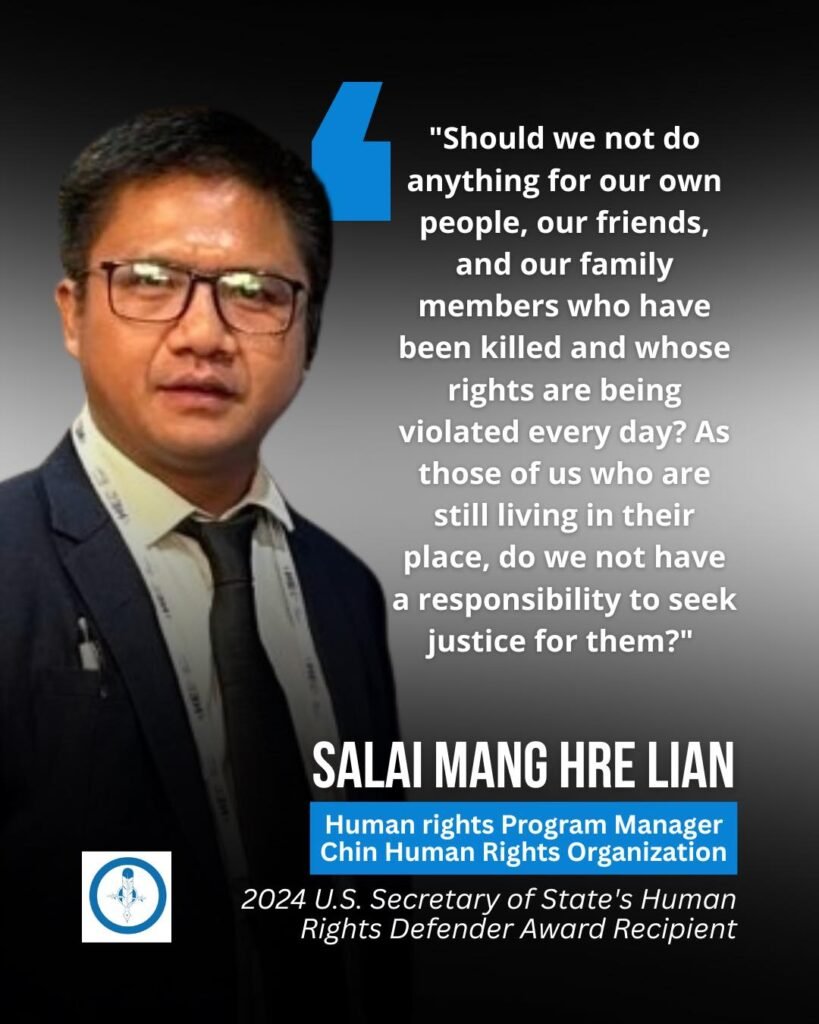
A: Finally, on behalf of CHRO and all those seeking justice, I want to say that our Chin people and the people across Myanmar, along with their families, are facing daily deaths and human rights violations. We cannot remain idle for those who are suffering. We, the survivors, have a responsibility to seek justice for them. Therefore, I want everyone to always remember our determination to represent and seek justice for the children and the elderly who are being killed.
Secondly, the Military Commission always claims that political problems must be solved through political means to achieve peace. Their intention is to try to make their crimes disappear once a political settlement is reached. We must be very cautious of this. Accountability must be held for the crimes committed against us, regardless of who is involved.
Even if we cannot fully achieve justice in our time, the next generation must continue to seek justice on behalf of the victims. These types of crimes cannot be hidden anywhere, nor should they be forgotten as time passes. Therefore, I want to conclude by saying that everyone has a duty to fight for justice.